
Site Events
The 25th International Conference on Computational Science and Its Applications
Themes
The ICCSA 2025 Conference Themes are the following (but not limited to)
1. Track: Computational Methods, Algorithms and Scientific Applications
Computational Biology
Computational Combustion
Computational Chemistry
Computational Fluid Dynamics
Computational Physics
Computational Geometry
Computational Mathematics
Computational Mechanics
Computational Electro-magnetics
Numerical Methods and Algorithms
2. Track: High Performance Computing and Networks
Parallel and Distributed Computing
Cluster Computing
Supercomputing
Cloud Computing
Autonomic Computing
P2P Computing
Mobile Computing
Edge Computing
Workflow Design and Practice
Computer and Network Architecture
3. Track: Geometric Modeling, Graphics and Visualization
Scientific Visualization
Computer Graphics
Computer Graphics
Geometric Modeling
Pattern Recognition
Image Processing
CAD/CAM
Web3D, Virtual and Augmented Reality
4. Track: Advanced and Emerging Applications
Biochemistry
Bioinformatics
Astrophysics
Biometric Modeling
Environmental, Climate and Weather Modeling
Geology and Geophysics
Nuclear Physics
Financial and Economical Modeling
Computational Journalism
5. Track: Information Systems and Technologies
Information Retrieval
Scientific Databases
Security Engineering
Risk Analysis
Risk Analysis
Reliability Engineering
Software Engineering
Data Mining
Artificial Intelligence
Machine Learning
Machine Learning
Learning Technologies
Web Based Computing
Web 2.0
Blockchain
Blockchain
6. Track: Urban and Regional Planning
Urban and regional growth
Sustainable urban and regional development
Socio-ecological systems
Open Data- Big Data
Cultural Heritage
Smart and Sustainable Cities
Mobility and Intelligent Transport Systems
Geographical Information Systems
Decision Support Systems
Complexity assessment and mapping
Logistics
Instructions for authors
Prospective authors are invited to submit papers, either to the General Tracks, to the Workshops/Sessions, Short Papers or PHD Showcase Papers. The papers are categorized as follows:
PLEASE PAY ATTENTION TO THE PAGE LENGTH ALLOWED!!!
- General Tracks/Workshop Papers: 12 to 18 pages
- LNCS Short Papers: 8 to 11 pages
- PHD Showcase Papers: 10 to 18 pages
All types of papers have to be formatted according to LNCS rules. The authors are kindly requested to adhere to the Springer Editorial Policies.
After review, the accepted papers will be published in the Springer-Verlag Lecture Notes in Computer Science (LNCS) volumes.
General Tracks papers will be published in an LNCS volume set named Conference Proceedings, while Workshop papers will be published in a separate LNCS volume set named Workshop Proceedings.
Each paper must be original and unpublished work, not submitted for publication elsewhere (copyright problems fall entirely under the authors' responsibility).
Each paper will be reviewed by at least three experts in the relevant field, ensuring the publication of only top-quality contributions.
Submission of a paper should be regarded as an undertaking; should the paper be accepted, at least one of the authors should register and present the paper orally at the conference. Failure to do so shall lead to the rejection of the application to attend next year's conference.
Paper Submission
The submission of contributions to ICCSA 2025 follows the following steps:
Authentication
The author must log in to the Electronic Submission System at https://ess.iccsa.org. If the author is using the system for the first time, they must register and respond to the email message they receive to validate the account (please check the SPAM folder if you do not receive such a validation request from ICCSA). At the end of the authentication phase, the author's home page will be displayed, with a summary of the author's submitted abstracts and papers.
Preliminary two-step submission (before review)
Each submission to ICCSA 2025 begins with an abstract submission (1st phase). This phase is facilitated because the author's information is collected during the registration phase at the Electronic Submission Site. If the author intends to submit the paper to a workshop (see https://www.iccsa.org/workshops), they must select the appropriate workshop from the list shown in the abstract submission form. To add co-authors, it is required that the author itself is already registered and validated by the system, as described in the Authentication section.
Submitting the abstract in advance is recommended to facilitate the conference organisation.
When preparing the full paper, the author must check the adopted layout against the LNCS format.
The author must submit the full paper (phase 2) in PDF format. The details of the paper are kept from the abstract, so this process is quite easy and fast.
The submitted paper will be sent for review after being analysed with the iThenticate platform to check for both Plagiarism and AI.
Papers exceeding 40% in plagiarism or AI will be rejected without proceeding further with the analysis by the reviewers.
The author can update the version of her/his paper before the submission deadline.
There is a possibility that reviewers may request relevant changes and, therefore, issue a conditional assessment requiring the author to upload the modified version of the paper, which the reviewer will analyse again before issuing the final evaluation. In this case, the author must complete the revision within the review period.
Final Camera Ready and Source Files submission (after review)
After receiving the notification of acceptance, the authors of accepted Papers will be asked to modify their papers according to the reviewers' recommendations and to submit the camera-ready version of their papers and all source files necessary to produce the final version to the Editor and sign the Copyright Transfer Form (phase 3) and upload the PDF file of the signed Copyright Transfer Form
Layout / Format
Formatting a full paper, the author is requested to strictly conform to the template provided by LNCS.
The detailed LNCS author's instructions and the related template files for the most popular document composition tools (LaTeX, Microsoft Word, LibreOffice) are available at the following URL: https://www.springer.com/it/computer-science/lncs/conference-proceedings-guidelines.
The final paper MUST be formatted according to the above instructions and possibly using the templates and macros provided by Springer.
Submitted papers that do not conform to the above layouts will be rejected.
Click here to see a graphic explaining how to upload the final files for the proceedings.
Conference Registration
Since publication of the papers in the proceedings is subject to conference registration and payment of the conference fee, all authors are kindly requested to register for the conference before the deadline to facilitate a smooth proceedings preparation.
To register and pay the related fee, click on the link at the top of the Home Page at https://ess.iccsa.org.
We recommend paying the fee by credit card, as it is the fastest and most reliable payment method.
If the bank transfer payment is selected, the author must pay great attention to the administrative people issuing the payment, specify the author's name and surname in the payment description, and proceed with uploading the receipt in https://ess.iccsa.org.
Registration fee payments cannot be refunded for changes or errors not attributable to ICCSA.
Presentation of the paper during the Conference
The Program at a Glance summarises the various sessions during the conference days, and the Detailed Program lists all papers in all sessions.
Clicking a session in the Program at a Glance will jump to the Detailed Program for that session.
Each presentation will last 20 minutes and include everything.
Templates for facilitating presentation preparation are available online.
For virtual presenters, a test room is available to become familiar with the Jitsi platform and run some tests.
The time is referred to as the venue time, UTC+1, Braga, Portugal.
Each presenter must access the virtual or physical room at least 10 minutes in advance and contact the session chair if they need help.
Committees
Honorary General Chairs
Bernady O. Apduhan, Kyushu Sangyo University, Japan
Kenneth C. J. Tan, Sardinia Systems, UK
General Chairs
Ana Maria A.C. Rocha, University of Minho, Portugal
David Taniar, Monash University, Australia
Osvaldo Gervasi, University of Perugia, Italy
Program Committee Chairs
Beniamino Murgante, University of Basilicata, Italy
Chiara Garau, University of Cagliari, Italy
International Advisory Committee
Jemal Abawajy, Deakin University, Australia
Dharma P. Agrawal, University of Cincinnati, USA
Jagannath Aryal, University of Melbourne, Australia
Rajkumar Buyya, Melbourne University, Australia
Claudia Bauzer Medeiros, University of Campinas, Brazil
Carl K. Chang, Iowa State University, USA
Elizabeth Chang, University of Sunshine Coast, Australia
Manfred M. Fisher, Vienna University of Economics and Business, Austria
Pierre Frankhauser, University of Franche-Comté / CNRS, France
Marina L. Gavrilova, University of Calgary, Canada
Sumi Helal, University of Florida, USA & University of Lancaster, UK
Bin Jiang, University of Gävle, Sweden
Yee Leung, Chinese University of Hong Kong, China
Biswajeet Pradhan, University of Technology Sydney, Australia
My Thai, University of Florida, USA
International Liaison Chairs
Giuseppe Borruso, University of Trieste, Italy
Elise De Donker, Western Michigan University, USA
Maria Noelia Faginas Lago, University of Perugia, Italy
Maria Irene Falcão, University of Minho, Portugal
Maria Noelia Faginas Lago, University of Perugia, Italy
Maria Irene Falcão, University of Minho, Portugal
Robert C. H. Hsu, Chung Hua University, Taiwan
Yeliz Karaca, University of Massachusetts, USA
Tae-Hoon Kim, Zhejiang University of Science and Technology, China
Vladimir Korkhov, St. Petersburg University, Russia
Takashi Naka, Kyushu Sangyo University, Japan
Rafael D.C. Santos, National Institute for Space Research, Brazil
Maribel Yasmina Santos, University of Minho, Portugal
Anastasia Stratigea, National Technical University of Athens, Greece
Nguyen Canh Thai, Thuyloi University, Vietnam
Kh Md Nahiduzzaman, Mohammed VI Polytechnic University (UM6P), Rabat, Morocco
Yeliz Karaca, University of Massachusetts, USA
Tae-Hoon Kim, Zhejiang University of Science and Technology, China
Vladimir Korkhov, St. Petersburg University, Russia
Takashi Naka, Kyushu Sangyo University, Japan
Rafael D.C. Santos, National Institute for Space Research, Brazil
Maribel Yasmina Santos, University of Minho, Portugal
Anastasia Stratigea, National Technical University of Athens, Greece
Nguyen Canh Thai, Thuyloi University, Vietnam
Kh Md Nahiduzzaman, Mohammed VI Polytechnic University (UM6P), Rabat, Morocco
Workshop and Session Organizing Chairs
Beniamino Murgante, University of Basilicata, Italy
Chiara Garau, University of Cagliari, Italy
Award Chair
Wenny Rahayu, La Trobe University, Australia
Publicity Committee Chairs
Elmer Dadios, De La Salle University, Philippines
Nataliia Kulabukhova, SberAutoTech, Russia
Daisuke Takahashi, Tsukuba University, Japan
Doan Quang Tu, Academy of Military Science and Technology, Hanoi, Vietnam
Shangwang Wang, Beijing University of Posts and Telecommunications, China
Local Organizing Committee Chairs
Maria Irene Falcao, Department of Mathematics, University of Minho, Portugal
Ana Cristina Braga, Department of Production and Systems, University of Minho, Portugal
Rui José, Department of Information Systems, University of Minho, Portugal
José Manuel Machado, Department of Informatics, University of Minho, Portugal
Jorge G. Rocha, Department of Informatics, University of Minho, Portugal
Technology Chair
Damiano Perri, University of Perugia, Italy
Program Committee
Vera Afreixo, University of Aveiro, Portugal
Vladimir Alarcon, Northern Gulf Institute, USA
Filipe Alvelos, University of Minho, Portugal
Debora Anelli, Polytechnic University of Bari, Italy
Muhammad Waqas Arshad, University of Bologna, Italy
Vittorio Astarita, University of Calabria, Italy
Hartmut Asche, Hasso-Plattner-Institut FüR Digital Engineering Ggmbh, Germany
Nizamettin Aydın, İstanbul Technical University, Türkiye
Ginevra Balletto, University of Cagliari, Italy
Nadia Balucani, University of Perugia, Italy
Socrates Basbas, Aristotle University of Thessaloniki, Greece
David Berti, ART SpA, Italy
Sandro Bimonte, CEMAGREF, TSCF, France
Ana Cristina Braga, University of Minho, Portugal
Tiziana Campisi, University of Enna KORE, Italy
Alessandra Capolupo, Polytechnic of Bari, Italy
Leocadio G. Casado , University of Almeria, Spain
Ilaria Catapano, National Research Council, IREA, Italy
Maria Cerreta, University of Naples "Federico II", Italy
Rachel Chien-Sing Lee, Sunway University, Malaysia
Birol Çiloğlugil, Ege University, Turkey
Florbela Maria da Cruz Domingues Correia, Polytechnic Institute of Viana do Castelo, Portugal
Alessandro Costantini, INFN, Italy
Roberto De Lotto, University of Pavia, Italy
Louiza de Macedo Mourelle, State University of Rio de Janeiro, Brazil
Marcelo De Paiva Guimaraes, Federal University of Sao Paulo, Brazil
Marco De Santis, University of Salerno, Italy
Frank Devai, London South Bank University, UK
Joana Matos Dias, University of Coimbra, Portugal
Aziz Dursun, Virginia Tech University, USA
Laila El Ghandour, Heriot Watt University, UK
M. Irene Falcao, University of Minho, Portugal
Florbela P. Fernandes, Polytechnic Institute of Bragança, Portugal
Paula Odete Fernandes, Polytechnic Institute of Bragança, Portugal
Adelaide de Fátima Baptista Valente Freitas, University of Aveiro, Portugal
Andreas Fricke, University of Potsdam, Germany
Raffaele Garrisi, Polizia di Stato, Italy
Ivan Gerace, University of Perugia, Italy
Maria Giaoutzi, National Technical University, Athens, Greece
Salvatore Giuffrida, University of Catania, Italy
Teresa Guarda, Universidad Estatal Peninsula de Santa Elena, Ecuador
Gabriel Guerrero Contreras, University of Cadiz, Spain
Malgorzata Hanzl, Technical University of Lodz, Poland
Maulana Adhinugraha Kiki, Telkom University, Indonesia
JungYoon Kim, Gachon University, South Korea
Clement Ho Cheung Leung, Chinese University of Hong Kong, China
Andrea Lombardi, University of Perugia, Italy
Marcos Mandado Alonso, University of Vigo, Spain
Ernesto Marcheggiani, Polytechnic University of Marche, Italy
Barbara Martelli, INFN, Italy
Antonino Marvuglia, Research Centre Henri Tudor, Luxembourg
Michele Mastroianni, University of Salerno, Italy
Hideo Matsufuru, High Energy Accelerator Research Organisation, Japan
Fernando Miranda, University of Minho, Portugal
Giuseppe Modica, University of Reggio Calabria, Italy
Majaz Moonis, University of Massachusetts, USA
Leila Moradi, University of Salerno, Italy
Nadia Nedjah, State University of Rio de Janeiro, Brazil
Paolo Nesi, University of Florence, Italy
Suzan Obaiys, University Malaya, Malaysia
Marcin Paprzycki, Polish Academy of Sciences, Poland
Eric Pardede, La Trobe University, Australia
Ana Isabel Pereira, Polytechnic Institute of Bragança, Portugal
Damiano Perri , University of Perugia, Italy
Massimiliano Petri, University of Pisa, Italy
Telmo Pinto, University of Minho, Portugal
Maurizio Pollino, Italian National Agency for New Technologies, Energy and Sustainable Economic Development, Italy
Marcos Quiles, Federal University of Sao Paulo, Brazil
Nguyen Huu Quynh, Thuyloi University, Vietnam
Albert Rimola, Universitat Autonoma de Barcelona, Spain
Humberto Rocha, INESC-Coimbra, Portugal
Marzio Rosi, University of Perugia, Italy
Lucia Saganeiti, University of L'Aquila, Italy
Francesco Scorza, University of Basilicata, Italy
Marco Paulo Seabra dos Reis, University of Coimbra, Portugal
Jie Shen, University of Michigan, USA
Bruno Sousa, University of Coimbra, Portugal
Francesco Tajani, Sapienza University of Rome, Italy
Daniela Tavano, University of Calabria, Italy
Ho Sy Tam, Thuyloi University, Vietnam
Deodato Tapete, Italian Space Agency ASI, Italy
Rodrigo Tapia Mcclung, Centro de Investigacion en Ciencias de Informacion Geoespacial, Mexico
Tarek Teba, University of Portsmouth , UK
Ana Paula Teixeira, University of Trás-os-Montes and Alto Douro, Portugal
Luis Teodoro, University of Oslo, Norway
Yiota Theodora, National Technical University of Athens, Greece
Elena Todella, Polithecnic of Turin, Italy
Graca Tomaz, Instituto Politécnico da Guarda, Portugal
Anna Tonazzini, National Research Council, Italy
Francesca Torrieri, Polithecnic of Milan, Italy
Vincenza Torrisi, University of Catania , Italy
Vincenzo Totaro, Polithecnic of Bari, Italy
Arianna Travaglini, University of Basilicata, Italy
Giuseppe A. Trunfio, University of Sassari, Italy
Stefanos Tsigdinos, National Technical University of Athens, Greece
Aime Tsinda, University of Rwanda, Rwanda
Elen Twrdy, University of Ljubljana, Slovenia
Doan Quang Tu, Academy of Military Science and Technology, Hanoi, Vietnam
Le Quang Tuan, Thuyloi University, Vietnam
Toshihiro Uchibayashi, Kyushu University, Japan
Fukuko Yuasa, High Energy Accelerator Research Organization, Japan
Paola Zamperlin, University of Pisa, Italy
Ljiljana Zivkovic, Republic Geodetic Authority, Serbia
Corrado Zoppi, University of Cagliari, Italy
The 26th International Conference on Computational Science and Its Applications
The 26th International Conference on Computational Science and Its Applications (ICCSA 2026) will be held on June 30- July 3, 2026 in collaboration with the University of Minho, Braga, Portugal.
ICCSA 2026 will be the next event in a series of highly successful International Conferences on Computational Science and Its Applications (ICCSA), previously held in Istanbul, Türkiye (2025), Hanoi, Vietnam (2024), Athens, Greece (2023), Malaga, Spain (2022), Cagliari, Italy (2021), Online (2020), in Saint Petersburg, Russia (2019), Melbourne, Australia (2018), Trieste, Italy (2017), Beijing. China (2016), Banff, Canada (2015), Guimaraes, Portugal (2014), Ho Chi Minh City, Vietnam (2013), Salvador de Bahia, Brazil (2012), Santander, Spain (2011), Fukuoka, Japan (2010), Suwon, Korea (2009), Perugia, Italy (2008), Kuala Lumpur, Malaysia (2007), Glasgow, UK (2006), Singapore (2005), Assisi, Italy (2004), Montreal, Canada (2003), and (as ICCS) in Amsterdam, The Netherlands (2002) and San Francisco, USA (2001). The first ICCSA conference was co-organized by C.J.K. Tan (UK) and M. Gavrilova (U of Calgary, Canada) in 2003.
Computational science is the central pillar of most present research, as well as industrial and commercial activities, and it plays a unique role in exploiting innovative information and communication technologies.
The ICCSA Conference offers an opportunity to discuss new issues, tackle complex problems, and find advanced solutions to shape new trends in Computational Science.
Submitted papers will be subject to stringent peer review by at least three experts and carefully evaluated based on originality, significance, technical soundness, and clarity of exposition.
All accepted papers have been published in the Springer Lecture Notes in Computer Science (LNCS) series, which is indexed by Scopus, EI Engineering Index, Thomson Reuters Conference Proceedings Citation Index (included in ISI Web of Science), and several other indexing services. The papers contain linked references, XML versions and citable DOI numbers.
You can check all ICCSA Conference volumes published by Springer since 2003 at the following URL: https://link.springer.com/conference/iccsa
Springer can manage ORCID for authors and Proceedings Volume Editors! Please add the ORCID related to each author of your submitted paper to avoid mismatches in bibliometric mapping!
Warning: Fake ICCSA Conference by WASET
We have noticed the existence of organisations such as WASET that run fake “conferences” to profit from registration fees. WASET often spoofs the names of real conferences. WASET claims to be organising a conference called ICCSA next year, which is a fake ICCSA conference.
The ICCSA Society has been organising the Real ICCSA conference since 2003. We are not involved with WASET. Please spread this news to your contacts and communities so that nobody mistakenly participates in such fake conferences.
WASET is a predatory publisher. Go to this Wiki Link: https://en.wikipedia.org/wiki/World_Academy_of_Science,_Engineering_and_Technology
The conference is organised in cooperation with:
 University of Minho, Portugal
This conference is proudly sponsored by:
 Springer International Publishing
 University of Perugia, Italy
 University of Basilicata, Italy
 Monash University, Australia
 Kyushu Sangyo University, Japan
University of Minho, Portugal
 University of Cagliari, Italy


Call for Workshops proposals
We encourage and invite interested parties to submit a proposal for organizing a Workshop. Workshop proposals will be collected and evaluated as they are received until November 27, 2025.
The workshop proposals should be submitted from the researcher's home page on the ICCSA 2026 Electronic Submission System: https://ess.iccsa.org.
The form to be filled will require the following information:
1) Title of the Workshop (Please select a simple name, close to the aim of the workshop. Do not include here the acronym.)
2) The Acronym of the Workshop including the year, 2026 (e.g.: VRA 2026)
3) The description of the Workshop, detailed Introduction, aim and purposes of the Workshop
4) Description of the topics (themes) of the workshop
5) List of all workshop organizers, which HAVE TO BE REGISTERED AT https://ess.iccsa.org in advance. *THIS IS A NEW REQUIREMENT FOR INCREASING SECURITY AND CORRECTNESS OF METADATA*. Please ask in advance all workshop organizers to register and respond to the email for VALIDATING THE ACCOUNT. The MAXIMUM number of organizers for a workshop is 6.
6) List of all Workshop's Program Committee members, which HAVE TO BE REGISTERED AT https://ess.iccsa.org in advance. Please ask in advance all workshop's program committee members to register and respond to the email for VALIDATING THE ACCOUNT .The workshop organizers cannot appear in this list.
7) Previous experience of the organizer(s) in organizing workshops (if any).
8) Name, the affiliation, and e-mail addresses of at least three colleagues of the organizer(s) who can assess the ability to organize a Workshop
9) A short description of how the workshop will be advertised.
The organization of successful workshops in previous editions of ICCSA (at least 5 papers accepted in the Proceedings, minimum no-show up, several discussions and questions during/after presentations), including the participation of the Workshop Organizers to the Conference, will be given priority ranking for acceptance.
The information provided by the workshop organizer(s) to the conference chairs shall remain strictly confidential.
The workshop organizers are responsible for all the organizational aspects, including soliciting submissions and providing the details of an adequate number of reviewers for the workshop papers. Workshop organizers are also fully responsible for ensuring that only high-quality papers are accepted for publication in the proceedings and for verifying the correctness of the layout adopted by the authors. They are also responsible for choosing the actual reviewers (three at a minimum) for each paper and for monitoring the reviewing process on the reviewing system, in collaboration with the Conference Program Chairs.
Papers with less than 3 reviews will be rejected.
Workshop organizers (or their deputies) are committed to attending ICCSA 2026, setting the order of presentations, and chairing their related workshop(s).
The publication in the Springer LNCS series still needs to be confirmed.
Paper submission
----------------
GENERAL TRACKS PAPERS:
The submitted paper must be between 12 and 18 pages long and formatted according to the LNCS rules.
WORKSHOP PAPERS:
The submitted paper must be between 12 and 18 pages long and formatted according to the LNCS rules.
PHD SHOWCASE PAPERS
The submitted paper must be between 10 and 18 pages long and formatted according to the LNCS rules.
SHORT PAPERS:
The submitted paper must be between 8 and 11 pages long and formatted according to the LNCS rules.
PROCEEDINGS
The proceedings will be published as a special series of volumes of the Lecture Notes on Computer Science (LNCS) edited by Springer (we are waiting for the acceptance by Springer) and indexed by Scopus, EI Engineering Index, Thomson Reuters Conference Proceedings Citation Index (included in ISI Web of Science), and several other indexing services. The papers will contain linked references, XML versions, and citable DOI numbers.
All reviewed papers will be checked against plagiarism and generative AI.
Contact Information:
Ana Maria A. C. Rocha
Department of Production and Systems
University of Minho
Portugal
Email: arocha <at> dps <dot> uminho <dot> pt
Osvaldo Gervasi
Department of Mathematics and Computer Science, University of Perugia
Via Vanvitelli, 1
06123 Perugia
Italy
Email: osvaldo <dot> gervasi <at> unipg <dot> it
URL: https://ogervasi.unipg.it
Registration Info
Registration to the Conference is mandatory to be enabled to attend the Sessions and to have the accepted Paper included in the published Conference Proceedings. To this end, the registration process and payment of the registration fee must be completed by May 8th, 2026. (see the Important Dates page).
Please follow the instructions herein described:
- To register for the conference, you must follow the link on your home page of the Electronic Submission System, the same used for submitting the paper(s). (If you haven't used it before, please register to the portal following the indication shown on the login page, and after logging in, proceed with the registration to the Conference.)
- If you are an author of the paper(s), you are kindly requested to pay attention to specify the paper(s) ID and title (i.e., 100 - My paper title). as shown on your web page in the Electronic Submission System https://ess.iccsa.org.
Each Registrant can specify up to 3 paper(s); the first is included in the registration fee, and the additional paper(s) are charged 200€ each. After completing the registration, you must proceed with the Payment according to the chosen method (Credit/Debit Card or Wire Transfer). At the bottom of the summary page received after submitting the registration info, click on the button Submit data for registering to ICCSA ... you will see a button for proceeding with the Credit/Debit Card payment or the instructions for making the Bank Wire Transfer payment.
- For participants who want to pay by Bank Transfer, please send your payment As Soon As Possible, as it takes some time to process the payment. We should receive your payment on or before the registration deadline. The registrant must pay Bank Wire Transfer and other related fees (please verify carefully during the Wire Transfer payment that all costs are charged to you). Failure to pay the required amount on this date will result in the paper(s) being excluded from the Conference Proceedings.
The Credit/Debit Card payment is available and is the preferred method (*no errors are possible identifying the registrant*). After you register, specifying as preferred method of payment via Credit/Debit Card, you'll be able to see the following images and the button at the bottom of the summary page related to the registration:

Click on the button Proceed with the payment through SOAR Secure Server, and you'll be directed to the Gateway for the Credit/Debit Card transaction.
Conference Fees
In-presence Conference
In presence conference fees cover the following:
- Attendance of Conference Delegates to the Sessions of the Conference
- Conference bag and material
- First published paper fee and free access to the Proceeding Volumes Sets
- all Conference Lunches
- all Coffee Breaks
- Welcome Reception
- Banquet Dinner
- Conference Tour(s)
The conference fees are as follows:
In presence participation
| Before reg. deadline | After reg. deadline | |
|---|---|---|
| Full Registration |
600 € | 700 € |
| Student/Post Doc Registration | 400 € | 500 € |
| Workshop Chair registration |
500€ |
600€ |
| Accompanying Person* (up to 3) | 200 € | 200€ |
| Additional paper (up to 2) | 200 € | 200 € |
| Additional Welcome Reception** | 35 € | 35 € |
| Additional Banquet Dinner** | 90 € | 90 € |
| Additional Half Day Tour Tickets** | 45 € | 45 € |
* The accompanying person fee is for non-academic participants (spouse, relatives and friends) who are not paper co-authors and enables them to participate in the Welcome Reception, Banquet Dinner, Guided Bus Tour(s) and all social events. Children under 12 are welcome free of charge.
Virtual Conference
In the case of the Virtual Conference, the registration fee covers the following:
- Attendance of Conference Delegates to the Sessions of the Virtual Conference
- First paper and free access to the Proceeding Volumes Sets
The Virtual registration fees are as follows:
| Before reg. deadline | After reg. deadline | |
|---|---|---|
| Registration Virtual Attendance | 300 € | 400 € |
| Additional paper (up to 2) |
200 € | 200 € |
Notes (read carefully):
1) For each Accepted Paper, one author must register, pay the registration fee, and present the paper, virtually or in person, in the conference session where the paper is scheduled. A detailed Program with associated links to connect to the virtual session rooms will be published before the event.
2) Once the registration payment is made, NO REFUND is available.
By Credit/Debit Card (online)
On your page in the Electronic Submission System (https://ess.iccsa.org), click the button that invites you to register for the Conference. Visa and Master Card Credit/Debit cards are allowed through the PayWay Secure Service
By Wire Transfer
NAME OF THE BANK: Crediumbria Banca di Credito Cooperativo
BANK ADDRESS: Via Stradone, Località Moiano, 06062 Città della Pieve - PG (Italy)
ACCOUNT HOLDER: ICCSA ETS
SWIFT Code: ICRAITRRTV0
IBAN: IT09D0707538380000000743098
Fiscal Information:
Name: The International Community on Computational Science and Its Applications - ICCSA ETS
address: Via Mazzini 89/A, 85100 Potenza (PZ), Italy
Fiscal ID: IT-96105650764
Please specify in the DESCRIPTION the following: NAME SURNAME ICCSA 2026 Registration (i.e. Anthony Smith ICCSA 2026 Registration).
Replace NAME and SURNAME with your full name. If administrative personnel issue the payment, ensure they use the syntax above. Having your payment correctly associated with your registration is crucial, since some banks cut the string to a short length!!!!
IMPORTANT REMINDERS:
1) The participant must pay the bank wire transfer-related fees (OUR).
2) After sending your registration payment by bank wire transfer, scan the bank receipt and upload it in the proper section of the https://ess.iccsa.org website.
3) ICCSA ETS is a not-for-profit organisation exempt from VAT. ICCSA ETS cannot issue invoices for such a reason.
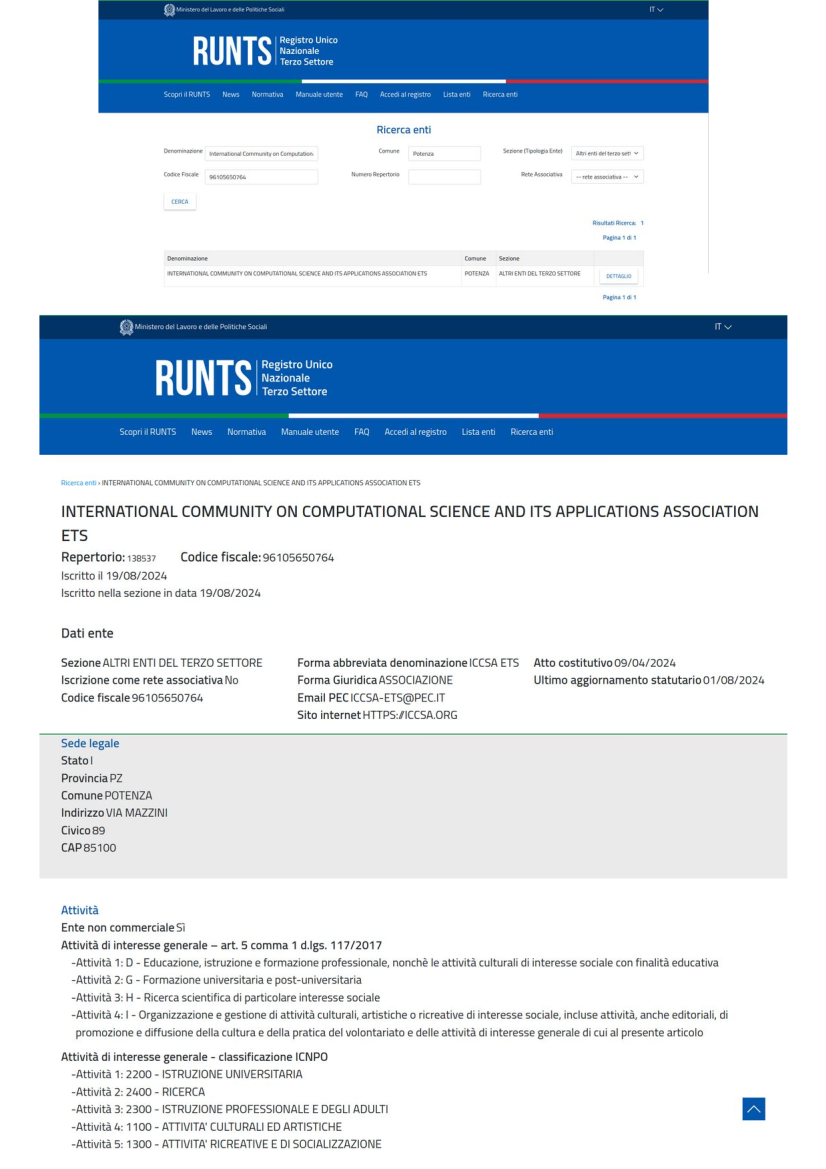
4) ICCSA ETS is registered to the Italian Registry of the 3rd sector RUNTS. Here is the entry for the International Community on Computational Science and Its Applications Association ETS in the RUNTS portal.
ORCID
Specifying the authors' ORCID will optimize the identification and tracing of the paper for proper bibliometric mapping
Springer can include ORCID for authors and editors of the proceedings to map the paper in the bibliometric info properly. See this announcement https://goo.gl/nAX4y8 and the guidelines https://goo.gl/oiMNAm (editor guidelines, section 4.7) for more information.
Authors are kindly requested to provide ORCID in their papers as an additional field of the authors' information.
The correct identification of the authors through their ORCID is crucial to correctly mapping publications and citations.
For more information, see https://goo.gl/hbsa4D.
Open Access
A proceedings paper can be published Open Access in various ways.
Gold Open Access
Springer Nature has recently changed the Golden Open Access fee to 2,390€ net (see https://www.springer.com/gp/computer-science/lncs/open-access-publishing-in-computer-proceedings for detailed information and the price list).
Green Open Access
Authors who wish to publish Open Access may publish their articles in Green Open Access using, for example, the Creative Commons CC-BY license, by posting the version submitted for publication (phase 3, Camera Ready Upload) on ResearchGate or another site, adding the following sentence in the acknowledgements:
“This preprint has not any post-submission improvements or corrections. The Version of Record of this contribution is published in [insert volume title], and is available online at https://doi.org/[insert DOI]”.
In such a case, Springer Nature has no embargo.
The volume number is displayed on your home page at https://ess.iccsa.org in the right column of the table showing your submissions.
The DOI will be known after the proceedings are published on the Springer Nature website.
Springer SharedIt
Another option is to highlight their access to the content through SpringerLink, and subsequently their right to distribute links to the SpringerLink Version of Record PDFs via our ShareIt mechanism.
As a brief explanation of SharedIt, you can log in to SpringerLink and refer to the end of the page (https://link.springer.com/chapter/10.1007/978-3-031-37126-4_37) to view the link in the attached graphics. This means you can read your paper following the TinyURL https://rdcu.be/dJxJI, and you can share this with other researchers/collaborators, who can read a PDF version of the paper in Springer’s system, whether or not they have a subscription. [The offer/mechanism is outlined here: https://www.springernature.com/gp/researchers/sharedit.]
Important dates
The important dates of ICCSA 2026 are the following:
October 20, 2025: Start of Workshop proposal submission
November 27, 2025: Deadline for Workshop proposal submission
December 1, 2025: Start of Abstract and Paper Submission
March 30, 2026: Deadline for abstract and paper submission to the General Tracks. Workshops may have their deadline.
April 20, 2026: Deadline for reviewers
April 27, 2026: Notification of Acceptance
May 8, 2026: Submission deadline for the final version of the Proceeding Paper (hard deadline)
May 8, 2026: Registration and payment end (hard deadline)
June 30 - July 3, 2026: ICCSA 2026 Conference